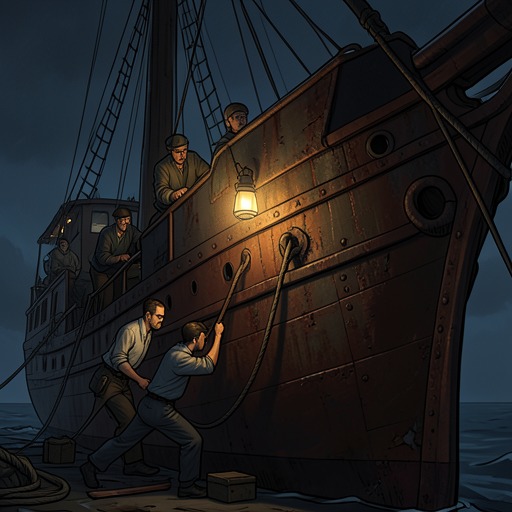
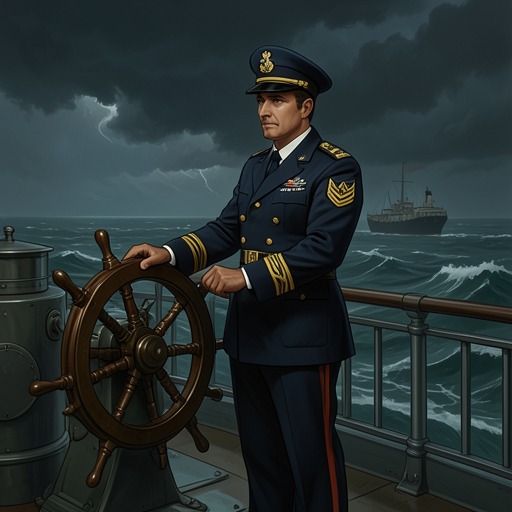
Kamikaze attack on the Caine
The Caine MutinyThe kamikaze attack on the Caine is the combat crisis in which Willie Keith moves from subordinate officer to effective shipboard leader. A Japanese plane struck the minesweeper off Okinawa while Tom Keefer had the conn; amid fire, exploding ammunition, and an order to abandon ship, Keith judged that the vessel could still be saved and organized the effort to keep it afloat. The attack tests not only the ship’s damage-control procedures but the officers’ capacity to judge danger: Keefer’s alarm sends men toward the water, while Keith’s assessment and orders restore a working chain of action.
Setting and Approach
The attack comes during the Pacific War, in a campaign whose scale has earlier been conveyed through the immense fleet that sailed from Hawaii toward Kwajalein. For Keith, the larger war had never seemed as reassuring as it might to a later historian: he imagined the Pacific as a path through mines, shore batteries, and air attacks. The Caine’s immediate work was less grand. It was rounding Okinawa’s southern end to reach Nakagusuku Wan and collect mail for the mine fleet, with no air-raid warning before the plane appeared.
The ship was in a calm sea on a gray, cloudy morning. Keith was in the chart house plotting bearings; Keefer, who rarely took the conn, was in command of the ship’s movement. When Urban called out the approaching plane, the Caine’s 20-millimeter guns opened fire spontaneously, joined by the other guns. Keith reached the starboard wing and saw the aircraft continue toward the ship despite the converging fire. As the plane closed in, the officers and men on the bridge took cover. Keith’s immediate fear gave way to a more intimate recognition: believing he might die, he felt an overwhelming regret that he had not married May Wynn after breaking with her. The thought had returned before in moments of fatigue or distress, but he had tried to dismiss it; now the prospect of losing her made the feeling impossible to treat as a passing weakness.
Impact and the Abandon-Ship Order
The plane hit amidships, and an explosion followed. Keith recovered quickly enough to enter the wheelhouse and announce the emergency over the public-address system. He ordered the ship to general quarters, dispatched firefighting and damage-control parties, and directed the crew to use the available fire-suppression equipment while leaving the decision to flood the magazines under his control. Smoke and the continuing threat from ammunition made the situation appear worse than its eventual damage reports showed.
The ready ammunition on the deckhouse began to explode. Keefer was injured and ordered the crew to abandon ship, then repeated the order over the public-address system. A fresh blast and the sight of sailors going over the side reinforced his belief that the Caine would not remain afloat. He moved toward the rail carrying a canvas sack, while officers and crew crowded to leave. Keith challenged the evacuation: he told Keefer that the men in the water had come from the bridge, not from the aft part of the ship, and asked to remain aboard with volunteers to fight the fire. Keefer did not heed the correction and jumped.
Keith Takes Control
Once the wheel was left unattended, the Caine swung broadside to the wind. The change cleared smoke from the bridge and gave Keith a better view of the ship. He saw that the vessel had barely moved, that the fires were limited, and that only a portion of the ship had been reported damaged. From that assessment came a marked change in his bearing: he felt calm and capable, and told Farrington that the Caine might be saved. Rather than treating the captain’s order as the final measure of the emergency, Keith used the visible condition of the ship to reassess what could still be done.
Keith set Farrington to start the auxiliary Kohler generator and restore power to the public-address system. He then addressed the crew as executive officer, asked them not to abandon ship, and explained what had been reported and what remained uncertain. His instructions were specific: fight the fire, work to raise steam for the main engines, keep the gunner’s mates ready to flood the magazines without doing so unless ordered, and troubleshoot the forward fireroom’s water supply. He also directed the men to close stop valves against possible flooding through damaged aft lines. The message combined technical tasks with a practical reason to stay: the ship might reach harbor under its own power, whereas abandoning it could leave the crew waiting on Okinawa for transport.
Seventeen minutes passed between the strike and the recovery of suction. Keith retained his composure as reports arrived and new problems emerged. During the next hour he maneuvered among the swimmers, stopping the screws when approaching them, and made a series of quick decisions while overseeing the rescue. The sequence contrasts the initial rush to leave with the disciplined work that followed Keith’s appeal: the crew’s attention returned to the damaged ship and to the men in the water.
Rescue and Significance
Keith saw Keefer among the swimmers, floating astern with the canvas sack. When the captain was brought alongside, a sailor secured a line around him and the crew hauled him aboard; Keith helped him to his feet. Keith then offered the conn back to Keefer and asked whether he felt able to take it. The moment brings the immediate contest over command to a close without erasing its difference in judgment: Keefer had ordered abandonment, while Keith had stayed, organized resistance to it, and directed the rescue.
The attack changes Keith’s relation to both danger and responsibility. Before the strike, the possibility of death had been an abstract feature of the war he feared; at the moment of impact, it clarified his regret over May, and after Keefer left the ship it became a test of practical command. The Caine’s survival is not presented as proof that danger was illusory: the fire, ammunition explosions, and men in the water were real. Its decisive turn comes instead from Keith’s reassessment of the situation and his ability to translate that judgment into orders others could follow.
The ship continued its wartime work after the attack. Seventeen days before the end of the war, it finally swept a mine in the China Sea. That later service places the kamikaze strike within the Caine’s broader, largely minesweeping role: the dramatic combat emergency was a rupture in a working life still shaped by operational duties. The novel also explicitly identifies the Caine and its crew as fictional, and cautions that its military circumstances and procedures have been altered; the attack is therefore an invented episode, not a record of an actual ship or crew.